



Last Updated on June 19, 2026 by DarkNet
The dark web is sold on a single promise: anonymity. And yet the people who ran its largest marketplaces — operations earning tens or hundreds of millions of dollars — keep ending up in handcuffs. Silk Road, AlphaBay, Hansa, Hydra, Archetyp: each was supposed to be untouchable, and each fell. How they fell tells you something important. Investigators almost never “break Tor.” Instead, they pull on the threads Tor was never designed to hide.
Tor hides where, not who — or what
It helps to be precise about what the technology actually does. Tor, and the onion services that host dark web sites, is built to conceal one thing: the network location of a user or a server. Done right, it makes it very hard to see which computer is talking to which.
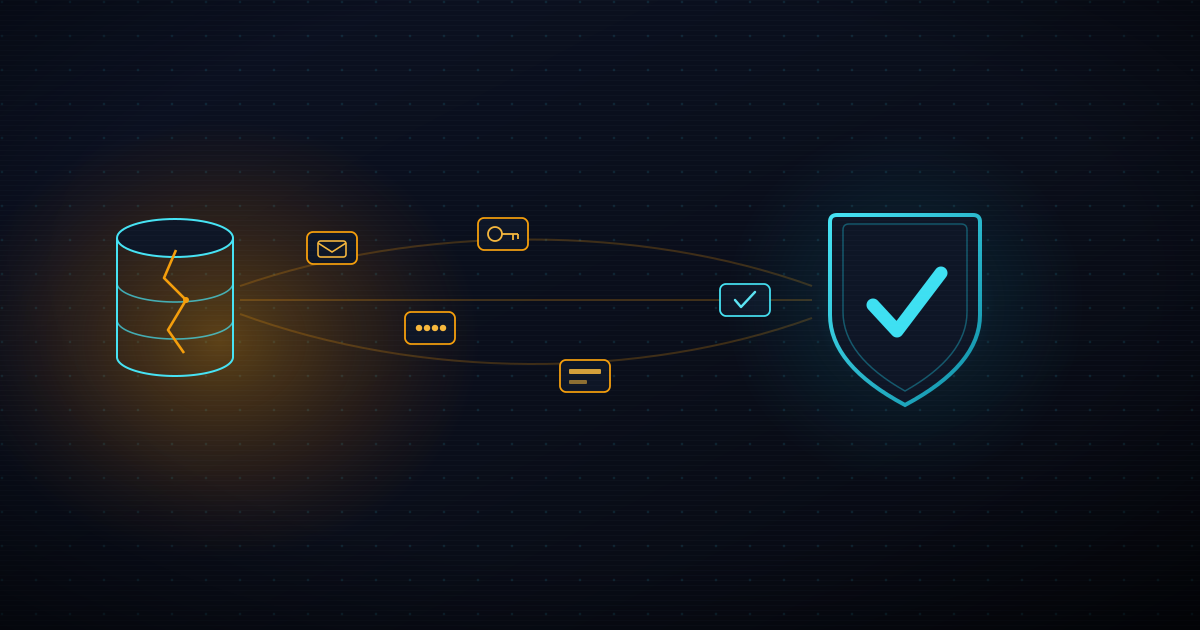
What Tor does nothing about is everything attached to that activity — the money that moves in and out, the physical servers running the code, the metadata a site generates, and the human being making decisions behind it. Nearly every major deanonymization comes down to one of those layers. The anonymity isn’t broken; it’s bypassed.
Following the money
The biggest thread is almost always financial. Dark web markets run on cryptocurrency, and the most common one — Bitcoin — records every transaction on a public ledger that never forgets. Specialized analysts and government units trace those flows, cluster addresses that appear to belong to the same actor, and watch for the moment the money touches the regulated world: a crypto exchange that collected someone’s ID, a reused wallet address, a predictable cash-out pattern. Each of those is a chance to attach a real name to anonymous-looking funds.
This is no longer a niche skill. In the 2025 takedown of Archetyp Market, tracing the platform’s crypto flows was a core part of an investigation that ran for years. What these cases keep demonstrating is simple: a public blockchain is a permanent trail, not a cloak.
The server is a physical object
A hidden service still runs on a real computer in a real building, and that machine can give away its own location. The classic example is Silk Road. According to the FBI, the site’s login page was misconfigured in a way that leaked the server’s true IP address — a “leaky CAPTCHA” that, on a page meant to be anonymous, returned an address belonging to no known Tor node. (Ulbricht’s defense later disputed this technical account, calling it implausible, but the government’s version held up in court.) From there, investigators imaged the server, and its access records pointed to an internet café near where Ulbricht was staying in San Francisco.
Once a server is located, it can be seized — and a seized server hands over everything at once: user databases, private messages, transaction logs, and fresh leads on vendors and buyers alike. That’s why a single piece of misconfigured infrastructure can end an entire marketplace.
One reused identity
The most human thread catches the most people. Strong technology can’t protect anyone from a mistake made years earlier under a different name.
Ross Ulbricht is the textbook case. Months before he was “Dread Pirate Roberts,” he promoted Silk Road on forums under the handle “altoid” — and later used that same handle to post a job listing that included his personal address, rossulbricht@gmail.com. He also asked a programming question on a public Q&A site, briefly under his real name, about connecting to a Tor hidden service. Investigators combing through old posts found the trail, and his identity unraveled from there.
Alexandre Cazes, who grew AlphaBay into a market more than ten times the size of Silk Road, made the same kind of error at scale. AlphaBay’s automated welcome and password-reset emails went out with a personal Hotmail address in the header: pimp_alex_91@hotmail.com. Cazes had used that address on tech forums as far back as 2008 and tied it to accounts in his real name. One line in a system-generated email led investigators to a Canadian citizen living in Thailand. When they raided his home in July 2017, he was logged in, on an unencrypted laptop holding the site’s passwords. As one FBI agent later described it, the operators felt so shielded by the technology that they grew careless.
The market itself might be a trap
Sometimes investigators don’t chase the operator at all — they become the operator. After AlphaBay went offline in 2017 in a way deliberately made to look like a technical outage, Dutch police revealed they had quietly seized Hansa, AlphaBay’s main rival, and had been running it themselves for weeks. As panicked AlphaBay refugees flooded in, they were signing up to a marketplace controlled by law enforcement — one that was logging their transactions, capturing metadata, and collecting thousands of delivery addresses that were later handed to Europol.
Undercover buys work on the same logic: the “vendor” or the “platform” on the other end may already be a government operation. On the dark web, there’s often no way to tell the difference.
The physical world still applies
For markets that ship physical goods, the last mile is the real world — and the real world can be intercepted. Packages cross borders and pass through postal systems that screen for contraband. Ulbricht’s case included a telling detail: he ordered counterfeit IDs from a Silk Road vendor, and the package was flagged in a routine customs check, which put agents at his door before his eventual arrest. No amount of onion routing protects a parcel once it’s in the mail.
What this actually means
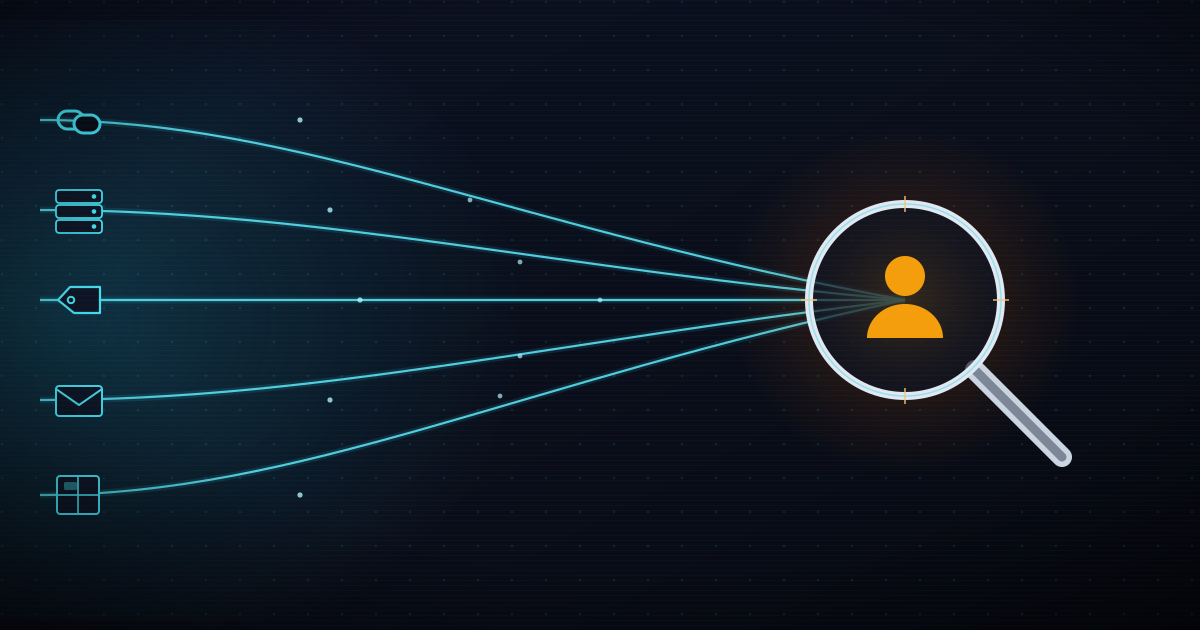
Notice what none of these stories require: a cracked encryption algorithm or a defeated Tor network. Deanonymization is almost always the patient accumulation of small, ordinary leaks — a reused username, a public ledger, a misconfigured page, a personal email in an automated message, a package in transit. Any one of them looks trivial on its own. Stacked together and pursued by multi-agency teams over months or years, they are more than enough.
That’s the honest takeaway for anyone trying to understand the dark web: its reputation for total anonymity is overstated. The technology can hide where you are. It can’t hide the trail of everything else you do — and that trail is what gets followed.
The short version
The dark web’s biggest operators weren’t undone by broken cryptography. They were undone by a public blockchain, a server that revealed its own address, a username reused from years before, a personal email buried in an automated message, and marketplaces that turned out to be run by police. “Anonymous” and “untraceable” are not the same thing.