



Last Updated on June 19, 2026 by DarkNet
Archetyp Market had a reputation as one of the most durable platforms on the dark web. It ran for five years — and law enforcement dismantled it in three days. In June 2025, an international operation coordinated by Europol shut down Archetyp Market, at the time the longest-running active darknet marketplace. This is more than another “site goes dark” headline: Archetyp’s story is a clear look at exactly how investigators reach the people who are convinced they’re anonymous.
What happened
Between June 11 and 13, 2025, police in six countries — Germany, the Netherlands, Romania, Spain, Sweden, and the United States — carried out a series of synchronized actions against the platform. Europol and Eurojust coordinated the effort, roughly 300 officers were involved on the ground, and German authorities led the case. The results were announced on June 16.
The central figure was the alleged administrator, a 30-year-old German national arrested at his home in Barcelona. Investigators believe he ran the marketplace as part of an organized criminal group. Alongside him, one moderator and six of the platform’s top vendors were arrested in Germany and Sweden. The infrastructure, hosted in the Netherlands, was taken offline during the operation, and authorities seized roughly €7.8 million (about $9 million) in assets — including luxury vehicles and cryptocurrency.
What Archetyp was, and why it mattered
Archetyp had been online since 2020 — more than five years, which is a long run for a darknet market, where most platforms last only months. By the time it was shut down, it had more than 600,000 registered users, and investigators put its total transaction volume above €250 million. Its catalog held more than 17,000 listings.
Archetyp stood out for another reason: it was one of the few marketplaces that openly allowed the sale of fentanyl and other potent synthetic opioids, alongside cocaine, MDMA, and amphetamines. That opioid profile is part of what made it a priority target — Europol described its removal as cutting off a major supply line for some of the world’s most dangerous substances. In scale and reputation, the platform was placed in the same conversation as defunct markets like Silk Road and Dream Market.
How investigators catch people who think they’re anonymous
The obvious question for any reader: if the dark web is built on anonymity, how does anyone get to the administrator at all? The answer isn’t “they cracked Tor.” It’s slow, methodical work across several fronts at once.
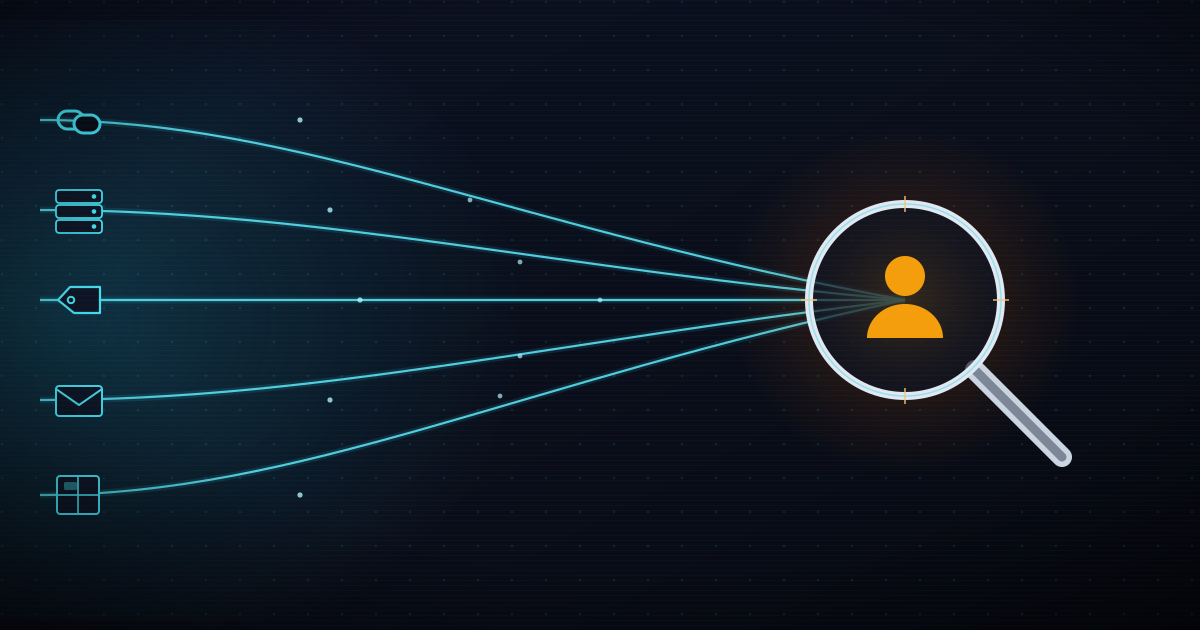
Tor genuinely hides where a user connects from. What it doesn’t hide is the money, the infrastructure, and human error. According to investigators, the Archetyp case ran for years and involved mapping the platform’s technical architecture, tracing its cryptocurrency flows, and conducting deep digital forensics. Any one of those trails looks insignificant on its own — but together they converge on a single point.
Cryptocurrency is a weak link here, not a shield. The blockchain is public: transactions can be traced, clustered, and eventually tied to a real identity — through an exchange, a money service, or a reused address. Servers physically exist somewhere, and hosting gets seized. And once investigators gain access to a platform’s internal data, it isn’t only the operators who are exposed — buyer lists and order histories become the raw material for new cases. That’s a recurring theme across every major takedown: “anonymous” does not mean “untraceable.”
What it means
Archetyp’s fall is a new turn of an old cycle. Silk Road in 2013, AlphaBay in 2017, Hydra in 2022 — each major takedown triggers a migration of users to successor markets, after which the ecosystem fragments and then consolidates around the few survivors. Archetyp itself grew on the ruins of earlier markets, and now it has cleared the way for the next ones.
But there’s a clear shift in the mechanics. These are no longer one-off national raids; they’re multi-year, multinational operations that hit administrators, top vendors, and infrastructure at the same time. Blockchain analytics and cross-border intelligence sharing have become the norm, which is exactly why markets now live shorter lives and tend to disappear suddenly — whether through a seizure or a sudden exit scam.
For the average reader, the real takeaway isn’t about one specific platform. It’s about the dark web’s reputation overall: it’s far less anonymous than people assume. The technology conceals one layer — location — but leaves the money, the metadata, and the operator’s mistakes wide open. And that’s usually enough.
The short version
Archetyp ran for five years and looked solid, but in June 2025 six countries dismantled it in three days, arrested the administrator in Barcelona, and seized €7.8 million in assets. The platform’s story is a clean illustration of a simple point: dark web anonymity holds only until the first mistake with money or infrastructure.