




Last Updated on February 3, 2026 by DarkNet
PGP remains a useful tool in darknet-adjacent communications, but it does not solve anonymity, metadata, or endpoint risks. This explainer outlines strengths, limits, and when it is a fit.

What “PGP for darknet work” means in 2026 (and what it does not protect)
Definition, scope, and the 2026 context
Pretty Good Privacy, commonly implemented as OpenPGP, is a standard for encrypting and signing data. In 2026, PGP encryption remains a widely supported way to secure message content and files across platforms. For darknet-adjacent use, it acts as a tool for content confidentiality and integrity checks between pseudonymous parties who may not share a real-world identity.
PGP is content protection, not a privacy shield for everything around the message. Treat it as a component in a larger operational picture that includes identity management, device hygiene, and safe communication practices.
What PGP protects: content and authenticity
PGP protects the plaintext of messages and files by encrypting them with recipients’ public keys. It also allows senders to attach signatures that verify that a known key produced the message and that the content was not altered. These are strong properties when keys are verified and devices are not compromised.
PGP security limitations: metadata, timing, and behavior
PGP does not hide metadata such as who communicated with whom, when, how often, or over which channel. PGP also does not provide traffic analysis resistance, cover timing patterns, or protect against side-channel leaks. These are common sources of PGP metadata leakage that can correlate identities and behavior even when content remains private.
What PGP does not protect: endpoints and accounts
Endpoints are the most common failure point. If your device is compromised or your account is misused, encryption does not help. Malware, clipboard capture, keystroke logging, and browser injections can defeat PGP by grabbing plaintext or keys before encryption or after decryption. This is core to any PGP threat model.
PGP’s core strengths: confidentiality, integrity, and identity signals
Confidentiality with broad compatibility
PGP works across email, forums, paste sites, file archives, and offline storage. That flexibility is valuable when parties cannot use the same app or when asynchronous communication is required. For many use cases, PGP provides dependable content encryption with long-term access to ciphertext and keys.
Integrity and “verify what was sent”
Digital signatures let receivers verify the message has not changed. This can reduce the risk of tampering or silent edits in public channels. The auditability of signatures is helpful where reputations and pseudonyms matter, as signatures can be replayed and checked by others.
Identity signals, not identity proof
Signatures are reliable signals that the same key signed a message. They are not the same as proven identity. Keys can be stolen, spoofed, or replaced, especially when the only verification happens through the same channel as the conversation. Treat signatures as consistency checks, not identity guarantees.
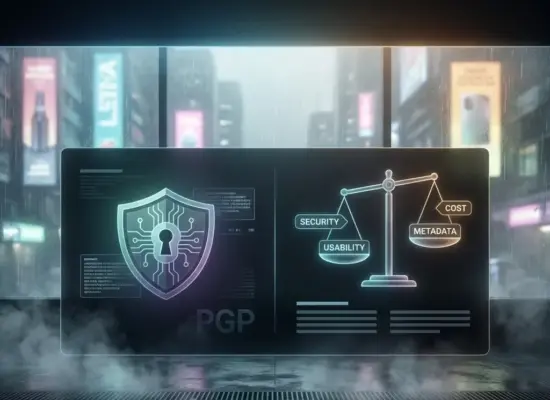
PGP pros and cons: summary table
| Benefits | Failure modes and tradeoffs |
|---|---|
| Strong content confidentiality across email, files, and posts | Does not hide metadata, timing, or social graph |
| Integrity and non-tampering checks via signatures | Lookalike keys, impersonation, and unverified fingerprints |
| Offline and asynchronous support | No native forward secrecy, long-lived keys increase correlation |
| Works without centralized servers | Key distribution is hard, revocation is slow and often ignored |
| Auditable artifacts for dispute resolution | Human error during copy paste or wrong recipient selection |
| Mature implementations and tooling | Complex user flows lead to mistakes and plaintext leakage |
Where PGP fails in practice: common OPSEC and usability pitfalls
Fingerprint verification that never happens
Many users skip fingerprint verification or rely on unverifiable claims in the same channel they use to exchange messages. Without independent verification, man in the middle key substitution remains a practical risk. Fingerprint verification should be treated as a separate problem from message exchange.
Key rotation and revocation that arrive too late
Long-lived keys accumulate risk. When compromises occur, revocation notices may not reach everyone, and old archives remain encrypted to compromised keys. Key rotation and revocation are essential concepts in 2026, but real-world execution is inconsistent across communities.
Copy paste and context switching errors
Switching windows, copying the wrong block, or encrypting to the wrong key are common. Misuse of armor blocks in web forms and the presence of multiple similar keys elevate human error rates. This is a core usability pitfall for PGP pros and cons assessments.
Overreliance on signatures for identity
Signatures prove key control at a moment in time, not real identity. If a key is stolen, an adversary can produce valid signatures. Equating signatures with identity proof creates false confidence that adversaries can exploit.
Modern threat model: endpoints, metadata, and social engineering vs cryptography
Endpoint security vs encryption
Most compromises occur on the device, not in the cryptography. Stealers that grab browser data, clipboards, or files can defeat PGP by capturing plaintext and keys. In darknet-adjacent contexts, endpoint hardening often matters more than switching ciphers.
Metadata correlation and timing analysis
Patterns like who messages whom, frequency, and timing are observables that PGP does not hide. Even if you route traffic through privacy networks, observable behavior can still correlate accounts. Recognize that content encryption does not mitigate metadata analysis.
Social engineering, key substitution, and seeded trust
Attackers exploit trust channels to distribute lookalike keys or to seed a new key as a “security upgrade.” Without out-of-band verification, users accept malicious keys and lock themselves into a compromised relationship. PGP threat model thinking must account for this social layer.
Supply chain and client misconfiguration
Malicious builds, browser extensions, or misconfigured plugins can alter messages or keys without user awareness. Given the decentralized nature of PGP tooling, supply-chain validation and client selection are non-trivial choices.

PGP vs modern alternatives in 2026: where each is a better fit
Forward secrecy vs PGP and session-based protocols
Modern messengers using the Signal Protocol provide forward secrecy by frequently rotating ephemeral keys. If a long-term key is compromised, past sessions remain safe. PGP typically uses long-lived keys without session-level forward secrecy. For live chat or short-lived conversations, forward secrecy is a strong advantage over PGP.
See the Signal protocol docs for design details: Signal documentation.
Group messaging and MLS
Messaging Layer Security targets scalable, efficient group encryption with strong properties for membership changes. In group contexts, MLS can be simpler and safer than ad hoc PGP approaches. Read the IETF specification: RFC 9420.
Asynchronous, file-centric, or archival use cases
PGP remains compelling when you need to publish an encrypted blob that many can store and decrypt later, or when you need signatures that remain auditable for years. In mailing lists, public posts with contact proofs, or file distribution, this flexibility is hard to match.
OpenPGP vs alternatives: feature parity and ecosystem
OpenPGP is a format and ecosystem, not one app. It works offline, across platforms, without relying on a single vendor. Modern app ecosystems offer better usability, forward secrecy, and group management but trade off openness and durability. Choose based on workflow and risk rather than brand.
Key management realities: trust, verification, and identity ambiguity on darknet
Fingerprint verification in pseudonymous spaces
Verification methods that do not leak identity are limited. Posting fingerprints on profiles can help, but if an adversary controls or mimics the profile, that check is weak. Independent, redundant signals improve confidence, yet anonymity needs often cap what is possible. Accept residual ambiguity.
Web of trust vs direct trust in 2026
The classic web of trust rarely reflects real-world trust in darknet contexts. Direct verification, reputation over time, and carefully curated trust anchors are the practical route. Avoid auto-importing random signatures that can pollute trust calculations.
Key rotation and revocation practices
Set expectations that keys are not permanent. Rotation reduces damage from unnoticed compromises, and revocation certificates help signal problems. The challenge is pushing these updates to everyone who needs them. Many users will continue to use old keys, so plan for transition overlap and clear public notices.
Lookalike key attacks and identity ambiguity
Attackers can publish keys with similar names, similar short IDs, or matching avatars. Always compare full fingerprints, and do not rely on short IDs or cosmetic cues. If multiple channels publish the same fingerprint consistently over time, confidence increases, but never reaches perfect certainty.
Operational friction: speed, mobile workflows, and human error rates
Mobile device and browser friction
PGP workflows on mobile can be slow and clumsy. Copy paste, lack of integrated key discovery, and attachment handling push users toward risky shortcuts. Compared to modern messengers, the friction is higher and the chance of user error rises.
Latency and availability constraints
Asynchronous threads and manual key exchange add delay. If rapid iteration is required, session-based messengers usually outperform PGP. When timing matters, slow crypto workflows can inadvertently reveal stress patterns or lead to skipped encryption.
Human error rates in manual crypto
Manual crypto is brittle. Users can encrypt to the wrong key, forget to sign, or post raw ciphertext to a wrong channel. The error surface is large, and in adversarial settings small mistakes can have outsized impact.
Workarounds that undermine security
Common workarounds include sending partial plaintext for speed, disabling signature checks, or caching sensitive data unencrypted for convenience. These erode the security benefits that PGP was meant to provide.
Legal, platform, and ecosystem considerations affecting PGP use
Crypto laws and compliance risks
Cryptography laws differ by country, and device searches can compel disclosure in some jurisdictions. Understand local rules before adopting any encryption tool. Reference guidance such as NIST SP 800-57 for key management concepts: NIST SP 800-57.
Platform policies and acceptable use
Some platforms restrict encrypted content or attachments, or throttle automated key sharing. Read acceptable-use policies and community rules to avoid account issues. The presence of encryption alone can raise scrutiny or moderation triggers.
Standards and implementation maturity
OpenPGP has a long history and multiple implementations. The original format is documented in RFC 4880 with ongoing updates in the ecosystem. See RFC 4880 and GnuPG docs at gnupg.org. Mature standards help, but do not fix usability problems.
Data retention and archival implications
Encrypted archives can persist for years, and if keys or passphrases are compromised later, older content may be exposed. Balance archival needs against exposure risks. Rotating keys and minimizing retention lowers long-term risk.
Decision framework: when PGP is worth it and when it is not
When PGP makes sense
PGP fits asynchronous exchanges, public posts that need verifiable contact proofs, file distribution, and mixed-platform environments. It is useful when participants cannot use the same messenger or need portable artifacts that can be audited later.
When alternatives fit better
If you need live conversation, group chat, and forward secrecy, modern encrypted messengers or MLS-based systems are often safer and faster to use. They reduce human error by integrating key management and message flow in a single app.
Practical checklist before adopting PGP
- Clarify your goals: content confidentiality, integrity, or identity signals.
- Assess endpoint posture first. Encryption does not fix compromised devices.
- Plan fingerprint verification that does not rely on the same channel.
- Define key rotation and revocation cadence. Publish clear transition notices.
- Limit data retention. Avoid long-lived archives unless you truly need them.
- Decide how you will handle lookalike keys and impersonation attempts.
- Test the workflow with low-risk content to gauge human error rates.
Aligning tool to threat model
Match tools to threats. If your main risk is traffic analysis, PGP alone will not help. If you face phishing and key substitution, you need robust verification processes. If your concern is content interception in a forum or mailbox, PGP can be a strong fit.
Frequently asked questions about PGP in darknet contexts (2026)
Is PGP encryption 2026 still safe?
Yes, when implemented correctly and used on uncompromised devices. The algorithms remain strong for typical use. Most failures come from key handling, verification gaps, and endpoint compromise.
Does PGP provide anonymity?
No. PGP hides content, not identity. Metadata, traffic patterns, and device fingerprints can still correlate accounts. Anonymity requires separate measures, and even then there are limits.
What about forward secrecy vs PGP?
PGP normally uses long-lived keys, so if a private key leaks, past messages to that key may be decrypted. Session protocols like Signal provide forward secrecy that limits this damage.
How should fingerprints be verified without doxing?
Use multiple independent pseudonymous channels and consistent publication over time. Seek corroboration across profiles. Avoid single-channel verification. Accept that certainty may remain imperfect.
What are signatures good for in darknet contexts?
Signatures prove that a known key produced a message and that it was not altered. They help maintain continuity of identity signals for pseudonymous accounts and enable public proofs of authorship.
Is email with PGP better than a modern messenger?
It depends. Email plus PGP can work across platforms and offline, but is slower and more error-prone. A modern messenger often offers better usability and forward secrecy, which improves practical security for chat.
What standard should I reference for OpenPGP formats?
The foundational spec is RFC 4880. For practical tooling, see GnuPG’s documentation. Links: RFC 4880, GnuPG documentation.
Can PGP help against phishing or social engineering?
Signatures can flag tampering or unknown keys, but social engineering often targets the user, not the crypto. Verification discipline and cautious behavior are still required.
Key takeaways
- PGP protects content and integrity, not anonymity or metadata.
- Endpoint security vs encryption is decisive. Compromised devices defeat PGP.
- Forward secrecy vs PGP is a real tradeoff. Session-based protocols win for chat.
- Fingerprint verification and key rotation and revocation are essential yet often neglected.
- Usability friction drives mistakes. Simpler tools can yield better real-world safety.
- OpenPGP vs alternatives is a workflow choice. Pick tools that match your threat model.
- Plan for identity ambiguity. Treat signatures as signals, not proof of identity.
- Avoid over-retention. Long-lived archives and keys increase correlation risks.